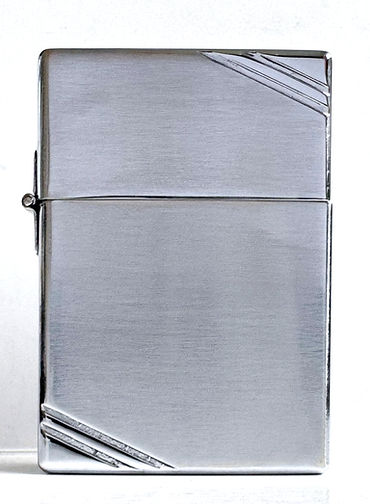
1934 Transitional Insert

This 1934 Zippo represents an important period in the evolution of early Zippo production. The lighter features the desirable Art Deco corner-line decoration associated with 1934 manufacture and is accompanied by a scarce transitional insert that illustrates Zippo's developmental engineering during its formative years.

This insert represents a scarce and important 1934 Zippo transitional design, bridging the gap between the taller 1933 insert and the more refined inserts that would follow later in the decade. It reflects a period when Zippo was still experimenting with construction methods and internal mechanisms, resulting in features that were only used for a relatively short time.

One of the most notable characteristics is the pair of squarish cam supports, which were not separate pieces but were sheared and bent directly from the chimney wall as a single piece of metal. These supports project outward from the chimney and carry the cam assembly, while the entire chimney structure is soldered to the insert body at its base. This construction is typical of early Zippo manufacturing, when production methods were still evolving and much of the assembly relied on labor-intensive fabrication techniques.

Equally significant is the use of the figure-8 cam. By late 1933, Zippo had already phased out the earlier hook cam, a design found on some of the earliest production lighters. The figure-8 cam represented an improvement in both operation and durability, and its presence on this insert places it firmly within the transitional period following the abandonment of the hook cam design. Collectors often regard the figure-8 cam as one of the defining features of early pre-war Zippo construction.
Compared to the preceding 1933 insert, this example is shorter in height, reflecting Zippo's continuing efforts to refine the proportions and fit of the insert within the lighter case. The combination of the shortened insert body, figure-8 cam, and integral squarish cam supports makes this configuration unique to a narrow window in Zippo's early production history.
The chimney itself displays the characteristic handcrafted appearance associated with early Zippo manufacture. Minor irregularities in the metalwork, solder joints, and forming techniques are reminders of a time before highly standardized mass production. These details are often appreciated by collectors as evidence of the company's formative years.

As a result, the 1934 transitional insert is much more than a functional component. It documents a pivotal stage in Zippo's technical development—after the retirement of the hook cam, but before the adoption of later cam support and insert designs. Surviving examples are seldom encountered today, making them highly desirable among collectors seeking to trace the evolution of the Zippo lighter from its earliest years.

What makes this example especially unusual is the survival of a complete set of factory service replacement parts that were intended for installation during a Zippo repair but were never fitted to the insert.

The surviving replacement components include:
Figure-8 cam
Cam rivet
Piston
Piston spring
Flint wheel
Flint wheel bushing
Flint wheel rivet
Flint spring
Flint spring screw
These parts remain separate from the insert and were never installed.
Because Zippo's repair department normally fitted replacement components during service, the vast majority of repair parts disappeared into working lighters and were never preserved as individual pieces. The survival of a complete, unused set of period replacement components alongside the insert is therefore an exceptionally rare occurrence.
This assemblage provides a unique view into both early Zippo manufacturing and the company's repair operations. The transitional insert documents a brief stage in Zippo's engineering development, while the uninstalled replacement parts offer insight into the components supplied for factory servicing during the early years of production.
Together, they form an uncommon historical record, preserving not only the lighter itself but also the very parts intended to extend its service life.
For advanced Zippo collectors, the significance of this example extends beyond the 1934 case and transitional insert. The presence of a complete, unused set of factory replacement components is a rare survival that is seldom encountered.
Rather than documenting a completed repair, this piece preserves a moment in the repair process that was never carried out. As a result, it offers collectors and researchers an unusual opportunity to examine both the transitional insert construction and the corresponding service parts exactly as they survived.

The combination of a 1934 decorated case, transitional welded-plate insert, and complete uninstalled replacement component set makes this an important and highly unusual artifact from Zippo's earliest years.