
1945/47 Steel Case Proto
This exceptionally unusual Zippo appears to represent a transitional or experimental steel-case prototype from the immediate post-war period, combining an early case configuration with a later 1947-era insert.
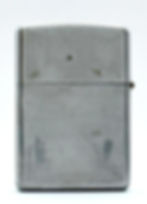
The most significant feature is the steel case itself. Following the wartime use of steel during World War II, Zippo was in the process of returning to conventional brass construction as normal production resumed. A steel case from this transitional period is therefore highly unusual and may represent experimentation with materials and construction before Zippo fully settled into its post-war production designs.
Adding to its significance, this prototype has a flat bottom, rather than the later rounded/formed bottom associated with regular post-war production.
Even more remarkable is its bottom stamp. The stamp follows the older pre-war style used on 1937–1941 Zippos, rather than the markings normally expected on a lighter from the 1945–1947 period.

The retention of the earlier stamping configuration on what appears to be a post-war experimental case strongly suggests that the case may have been produced using existing tooling, dies, or manufacturing methods from the pre-war period, rather than being a conventional production case.
The insert provides another important clue. It features characteristics associated with the 1947 period, including the 14-hole chimney and slanted-cut flint wheel.
The mixed-period construction should not necessarily be viewed as evidence that the lighter was assembled incorrectly. Prototype and experimental pieces can contain components from different stages of development, particularly when they were produced or retained within the factory environment.
The 4-barrel hinge is especially significant. It places the case firmly within the earlier hinge tradition and is another feature that separates this piece from the more standardized post-war Zippos that followed.

The combination of a 4-barrel hinge and flat bottom gives the case an unmistakably early character, while its steel construction suggests experimentation during the post-war transition.
The bottom stamp is arguably one of the most fascinating aspects of this piece.
If the case itself is genuinely a post-war steel prototype, the presence of the 1937–1941-style stamp could indicate that Zippo reused older stamping equipment or dies during the experimental stage. It may also indicate that the case was produced during a period when Zippo was experimenting with how to restart production after the war, before the standardized post-war case and stamping configurations were established.
This would explain why the lighter does not conform neatly to the normal Zippo dating system.
Rather than being a conventional 1946 or 1947 production Zippo, it may represent a developmental piece, with the case originating from an experimental production run and a later insert being fitted either during factory testing or subsequently.
The fact that this example retains an older flat-bottom construction and pre-war bottom stamp, while carrying a later 1947-type insert, makes it considerably more interesting than an ordinary period Zippo.
